To be released soon – hoping within the next week.

FRONT COVER

BACK COVER
To be released soon – hoping within the next week.
FRONT COVER
BACK COVER
Thank you writer and blogger Amy Reade for featuring me today on her blog Reade and Write. I answered questions for readers, and have been invited to do the same in the future for writers. (I’m waiting for YOM KILLER to go live so I can append a buy link and photo of the cover to the blog! 😀)
You can read my ponderings at: http://wp.me/p3YJIY-os.
FYI to fans of TALK DIRTY YIDDISH: I have had the rights to the book returned to me. It will still be available online until the inventory is sold out. (And, of course, in stores that carry it and haven’t sold out, but those stores won’t be able to order additional copies.) At the moment, the major site that still has copies for sale is Barnes and Noble (http://tinyurl.com/zygmobv).
I plan to edit the book (and delete a repeated paragraph that snuck into the original, despite professional editing), and add an index of words and phrases at the back. (The publisher didn’t allow one because it didn’t fit with the formatting of the other books in the series.)
It will eventually be reissued in a 2nd edition with a different cover (I couldn’t get the rights to the original), probably as a self-published book and e-book.
I’ll let everyone know when the new edition is “live.”
Have you heard there’s a new cruise line, the Ess Ess Mein Kind? (Very old bi-lingual pun: Yiddish for “Eat, eat, my child.”) Here’s a chance to eat well without risking seasickness.
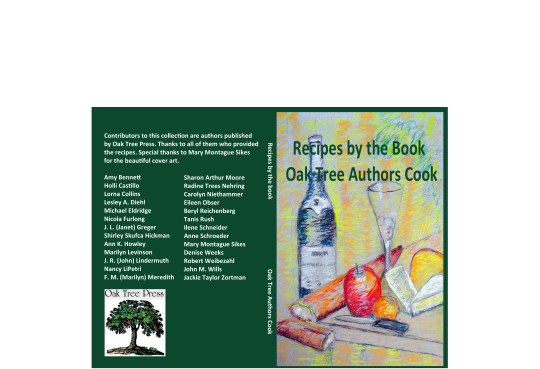
RECIPES BY THE BOOK: OAK TREE AUTHORS COOK is now available from Amazon in a full-color version. Order at: http://tinyurl.com/zrmhvdr
Or you can purchase a less expensive black-and-white version (interior illustrations in b/w; cover still full color) at: http://tinyurl.com/pcejv9d
Great for gift giving and for personal use – and a way to find out more about your favorite OTP authors.
And, no, the recipes aren’t Kosher. Except mine. And the vegetarian and vegan ones.
I just posted an invitation on Facebook for writer friends to join in a game I made up. Or maybe I read about it somewhere and plagiarized it. If so, apologies, and let me know so I can give proper attribution.
Describe your book(s) in a haiku.
I’ll start with CHANUKAH GUILT:
Rabbi finds herself
Enmeshed in suicide case.
Or was it murder?
And I’ll continue with UNLEAVENED DEAD:
Why did couple die?
Who killed man with hidden past?
Rabbi uncovers all.
And my new (yet to be released) book YOM KILLER:
Mom found unconscious.
Accident or planned attack?
Family finds truth.
… for mentioning me alongside Diane Mott Davidson, Nancy Cohen, and Janet Evanovich. I hope I’m one whose humor works!
“What’s funny to me may not tickle your funny bone, so it’s always chancy inserting humor into a murder mystery, yet I do it as do other cozy writers such as Diane Mott Davidson, Nancy Cohen, Rabbi Ilene Schneider and Janet Evanovich. Some of the humor works, other does not.
Read her thoughts on “What’s the Problem with Cozy Mysteries” on Judy Mehl’s blog at http://wp.me/p3yeUA-1nc.
Now that the fate of YOM KILLER, the 3rd Rabbi Aviva Cohen Mystery, is in the hands of my publisher, it’s time to think about book #4. I’m undecided about the title: High Holy Daze? Purim Plotz? Simchat Terror? Shabbat Whine? Plenty of holidays, but I’m running short of puns.
Being a pantser (one who writes by the seat of her pants), I have no idea how I’m going to get from point A (below) to point Z (figured out in my head). If you’re interested in Point A, read on.
I love mysteries. I always enjoy trying to solve an enigma, whether it’s a word puzzle, a jigsaw puzzle, a whodunit, or a real life dilemma.
I often try to figure out what motivates people to act the way they do. I read history and wonder how such cruelty could have existed. Then I read the news and wonder how such cruelty could still exist. Some people go out and do terrible things, with no signs of remorse or conscience or even realization that what they’re doing is wrong. And then, when I despair about the human condition, others go out and put themselves in danger to help strangers.
I marvel at the human mind. What inspired someone to take an unappetizing creature like a lobster, throw it into a pot of boiling water, crack the shell, remove the “meat,” and dredge it through melted butter? What motivated someone to look at a prickly pineapple and think, “Gee, I bet there’s something juicy and sweet under the rind”? Who decided to chew the bark of a willow tree to cure a headache?
And the workings of the minds of geniuses – the Descartes and Galileos and Newtons and Lovelaces and Einsteins and Marconis and Edisons and Hoppers, and all the others who thought up math and technology and science – are completely baffing to me.
They’re all grist for the mill. Or maybe I should say they’re all impulses to get the synapses in my brain to fire and keep me young. If it’s true that solving puzzles helps delay the aging process, I should live forever.
The past few years, I succeeded in solving a couple of real life mysteries. Why did a young woman commit suicide? What happened to the carbon monoxide detector that should have saved a couple’s life? Why did my mother have a contusion on the back of her head when she accidentally fell forward? What was I going to do about my first ex-husband? But my newest “case” proved to be the most baffling of all: how did human bones wind up under a pile of discarded Judaica books being stored in a trunk in the attic of a condemned synagogue building?
And what quirk of quantum randomness caused me to be the one to find them?
You can see/hear this presentation on https://www.youtube.com/watch?v=EMpyXvGQ8BE
Hello, Literary Gladiators. My name is Ilene Schneider, and I thank Josh Caporale for inviting me to post the inaugural entry in the Guest Contributor Series. My claim to fame among Literary Gladiators is as Ari Schneider-Gans’s mother, but I am also a published author, with two mystery novels and a nonfiction book to my credit, along with various contributions to academic anthologies and newspaper opinion columns.
Whenever I do presentations and book readings, I am asked questions about my writing process and publishing experiences. I’ve collected the most frequently asked questions to answer for you today.
I’m often asked when I began writing. I have always been a writer, beginning with my parodies of nursery rhymes when I was about 8. At camp, I hated sports, so I volunteered to run the camp newspaper during the free period. I fell in love with journalism. I was 12. My first nationally published work was a eulogy of John F. Kennedy accepted by Ingénue Magazine when I was 15. I was a communication major in college, concentrating on journalism. I was an editor of my college paper, and a founding editor of a Jewish student paper in Boston. My goal was to be the first woman editor of the New York Times. Even though I got sidetracked, and instead became one of the first women to be ordained as a rabbi in the US, I still continued to write. I was the editor of a Jewish student paper in Philadelphia while I was in rabbinical school. After that, my writings were academic or curriculum design or reports or other forms of nonfiction.
About 10 years ago, I found myself temporarily underemployed. In case you’re wondering, that’s a euphemism for between jobs, also a euphemism. I’ve been a voracious reader since first grade – it would have been earlier if my mother hadn’t been afraid the teachers would be angry with her if she taught me to read before I started school. For quite some time, I had wondered how certain books had gotten published, let alone made the best seller lists. But I also believed it was dishonest of me to criticize books if I hadn’t written one. So I did. It took a while, and it took even longer before I stopped trying to find an agent and concentrated instead on looking for a small publisher who did not require an agent and was willing to take a chance on an unpublished author. Eventually I did.
Which segues into the next question: how I got published. In all three cases, it was a matter more of whom I knew rather than what I wrote. For my first book in the Rabbi Aviva Cohen Mystery Series, Chanukah Guilt, I queried a woman I had been chatting with online after she mentioned she had recently started a small independent press. So many months had passed between when I had submitted my manuscript and when she emailed that she wanted to publish the book that I had forgotten I had written to her.
The second book, the nonfiction Talk Dirty Yiddish followed a similar path, but with one difference: the publisher queried me. Again, I had met someone online who was the acquisition editor for a large nonfiction publisher. She emailed me that they were starting a new line of books called “Talk Dirty …” and wanted to know if I would be interested in writing the Yiddish version. She didn’t consider my lack of fluency in Yiddish to be an obstacle, as I am experienced in doing research. I realized that if I didn’t write the book, they’d hire someone else. I would read the book and think, “I could have done that,” so I accepted.
By the time I had finished the second book in the mystery series, Unleavened Dead, my first publisher had closed down. For the third time, I contacted an online acquaintance who was acquisitions editor for a small press. Her response was, “I was hoping you’d ask. I love accepting books from people I know.” I’ve been with that publisher, Oak Tree Press, ever since. I am currently editing and proof reading the manuscript of my third mystery, Yom Killer – you can credit Ari for the title – and am about to send it off to Oak Tree.
And that leads to the next question: what is my typical writing day. I don’t have a typical day. For almost eight years after the publication of Chanukah Guilt, I still had a day job, as a chaplain for a hospice, which can be emotionally draining. I often found myself reading, my favorite way to unwind, when I should have been writing. Now that I have retired, I find other ways to procrastinate – volunteer work, gardening, birding, traveling, knee replacement surgeries, surfing the ‘net under the guise of research, and, of course, reading so I can keep up with the so-called competition.
I cannot write at home, so I take myself off to a Dunkin’ Donuts or Starbucks or some other location that doesn’t mind people using them as an office and has wall plugs to recharge laptop batteries. I find I can concentrate when there is ambient noise I can ignore because it has nothing to do with me. At home, my unwashed laundry and unwatered plants, not to mention telemarketers who ignore the Do-Not-Call list, are always interrupting my train of thought.
And I need to keep track of those thoughts, as I am not a plotter – a writer who outlines and plans every plot twist and scene and nuance of character – but a pantser – one who writes by the seat of her pants. As such, my characters are in control. They tell me what is going to happen. I have a general idea of the story, but the characters often take me in different and unexpected directions. I am then forced to figure out how to get the characters out of whatever corner they’ve made me write them into.
Because my characters tend to take on a life of their own, I sometimes discover that my readers see things in them that I had never intended. For example, I had written the character of Aviva’s first ex-husband – she’s been twice married and divorced – so she would have a close contact in the police department after he was appointed the temporary Director of Public Safety for her town. I had expected him to be an important albeit fairly minor character. But readers kept asking me about Aviva’s relationship with him and how it was going to develop. I hadn’t planned anything further, but did explore their interactions in the second book and expanded it even further in the third.
Another example is when readers tell me they were on the edge of their seats during certain scenes, which I had not considered to be all that suspenseful. But, of course, I knew what the outcome would be.
Which brings up the issue of whether my characters are based on people I know. No, they’re not. My main characters are never based on real people. At the most, they are composites. But I do observe people, so some of my secondary characters are based on strangers, people I see at bookstore cafés or restaurants or stores, and my idle speculations about them. I am also an unabashed eavesdropper, and sometimes overhear conversations, particularly one-sided cell phone ones, that I include in my books.
I am often asked what advice I would give to aspiring writers. I have four bits of advice for aspiring writers. They’re not original with me, but have stood me in good stead.
And finally, why do I write? It’s so I can answer the question “What do you do?” by answering, “I kill people.”
But, of course, there is a much more important and serious answer: the sense of accomplishment and satisfaction when people tell me how much they enjoy reading what I write, the chance to entertain others. When UNLEAVENED DEAD was published, a woman who serves with me on the board of our local library bought the book. She was a big fan of CHANUKAH GUILT, and had been waiting patiently for book #2. Her husband of many years had died just a few months before, and she was still mourning the loss. When she came to my book launch party a few weeks after she had bought the book, I asked her if she had read it and enjoyed it. She said, “Enjoyed it? I got home and began reading it in bed. I went to sleep with a smile on my face for the next three nights.” That to me is not just satisfying, but a symbol of success. It was the best praise I could have received.
I know there are a lot of questions I haven’t answered. You can always reach me by email at rabbi.author@yahoo.com. And please follow my blog at http://rabbiauthor.com or friend me on FaceBook at http://www.facebook.com/rabbi.author.
Thank you for joining me on Literary Gladiators. And keep reading.
I’ve been lax about updating my blog entries because whenever I decide to share an insight or event, whether personal or political (aren’t they the same?) or book-related, I post it on Facebook. I’m aware that not everyone who reads my blog is a Facebook friend or follower, so I decided I’d collect the comments and pictures I had posed during an incredible three-week trip Gary and I took in August to Seattle, Vancouver, southwest Alaska (on a cruise through the Inner Passage with stops in Ketchikan, Juneau, Skagway, and Glacier Bay), Denali, and Fairbanks.
But I discovered a problem when I began to write my travelogue: a written description of a trip, even complete with pictures, is boring. Remember those old film strips teachers would show in class? Boring. Remember going to dinner at some elderly (to you) relatives’ house and later having to sit through an interminably long slide show of their vacation? Boring. Remember bringing home a new boyfriend or girlfriend and having your parents pull out all your baby pictures? Boring. Not to mention embarrassing.
I was on the trip, and I can assure you the reality was terrific. We were never bored. We did things we didn’t think we’d ever do, saw things we’d never seen, had experiences we’d never imagined, reconnected with friends we hadn’t seen for forty or more years. But when I read what I had written, I was bored. I was bored while writing it. Even the pictures were boring – after a while, all mountains volcanoes, rivers, waterfalls look the same.
Doling out the information, complete with my wryly humorous (to my mind anyway) observations, in short bits once a day (more or less) may have been entertaining. Putting it into a running narrative is … have I said this yet? … boring.
So instead of a travelogue, here are some life lessons I culled along the way. In no particular order. And without relevant pictures.


