Blog posts about the Rabbi Aviva Cohen Mysteries and their author Rabbi Ilene Schneider

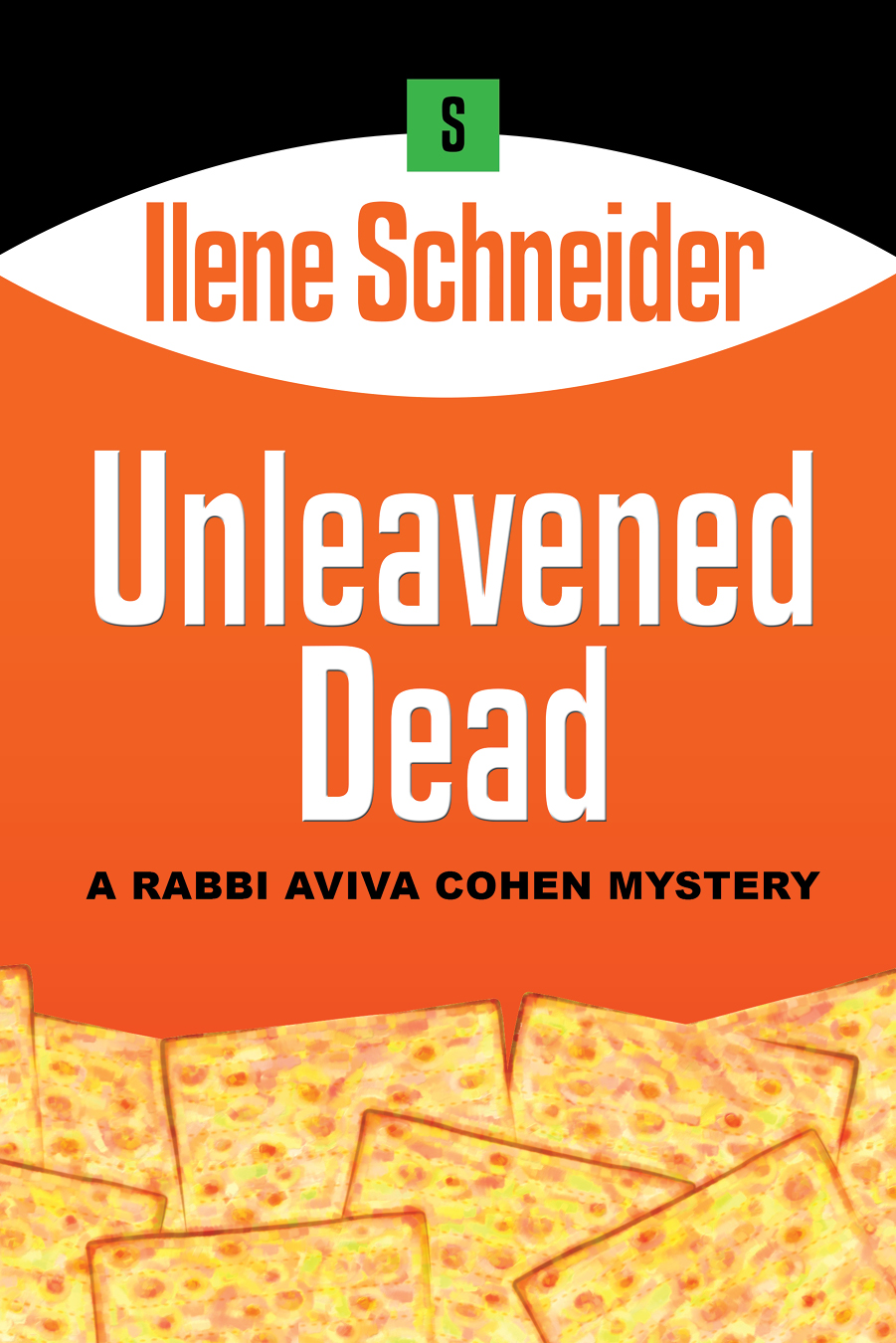
 I asked five authors whose works I enjoy (and whom I have met) to read the unedited manuscript of Unleavened Dead, and, if they liked the book, to write a blurb to appear on the back cover. All five accepted, and all five wrote nice mini-reviews. In order to fit all five onto the back cover (along with the book description, my bio, and my picture), we had to cut down the already short comments to a few snippets.

All five have given me permission to post the full blurbs on my website/blog. Please help me thank them by clicking on the links for their websites. And, even better, read their books. You won’t be disappointed.


And here they are (in alphabetical order):


In Ilene Schneider’s Unleavened Dead, Rabbi Aviva Cohen is funny, smart, and believable. Somehow between worrying about her job, her weight, and her exes, she keeps getting involved in murders, but her slide into crime-solving is seamless. A smoothly written and entirely enjoyable read!

– Sheila Connolly, Agatha Award nominated author of the Orchard Mysteries and the Museum Mysteries; www.sheilaconnolly.com


Rabbi Aviva is back – and never in better form – if never more stressed. The pressure of Passover preparations with a wedding the night before, Aviva’s complicated relationship with her ex-husband and turmoil in her niece’s life should be enough, but then people close to Aviva start dying in suspicious circumstances. And then the mob shows up. As always, Schneider gives us a wonderful picture of life in a Jewish community – Chaim Potok with a wacky sense of humor.

– Donna Fletcher Crow, A Darkly Hidden Truth, The Monastery Murders 2; www.DonnaFletcherCrow.com


Ilene Schneider’s Unleavened Dead is like dishing with your girlfriend the rabbi, who leads a really interesting life. Three mysterious deaths, an evil therapist, a crowd of menacing murder suspects, a tangle of shul politics, a still-attractive ex-husband – What’s not to like?

– Kate Gallison, author of The Edge of Ruin (as Irene Fleming), winner of the New Jersey Studies Academic Alliance fiction award; www.kategallison.com.


Oy vey, this book made me smile. With two good mysteries, a dysfunctional family, and an inside look at life as a female rabbi-cum-amateur sleuth, Unleavened Dead is a book you don’t want to miss.

–  Barb Goffman, Agatha, Anthony, and Macavity award-nominated author of short stories including “The Lord Is My Shamus;” www.barbgoffman.com


Once again, the inimitable Aviva Cohen uses her rabbinic seichel and intuition to solve crime- this time the apparent “accidental” deaths of two of her congregants. You don’t have to be Jewish to root for this twice divorced, 50 something, slightly overweight, feisty heroine. This is a delightful cozy mystery for everyone!

–  Deborah Shlian, co-author of the award winning Sammy Greene series; www.shlian.com


The wait is almost over. You can now pre-order UNLEAVENED DEAD, the 2nd Rabbi Aviva Cohen Mystery, from the Oak Tree Press site. Scroll down – the books are listed in alphabetical order. Buy early and often!

http://oaktreebooks.com/Shop%20OTP.htm

Both my novels have been (okay, in the case of Unleavened Dead, is about to be) published by small presses. The two I have been associated with, Swimming Kangaroo Press and Oak Tree Press, operate on the same principles as a large publisher: editing, book cover design, formatting for both the hard copies and e-books, press releases, review copies, distribution deals with all the major companies are provided by the publisher, at no cost to the writer. They pay royalties – at a slightly higher rate, I have found, than the standard offered by the large publishers – but there was no advance. They also print on demand, meaning instead of risking that 10,000 copies of an unsold book will wind up in a landfill, they print the number of books that have been ordered by the distributors, as needed. It’s a very green alternative to the traditional print run.

Oh, and unlike the Big Six (although the number of large publishing houses may be even less by the time you read this), small presses do not require submissions by agents only, and are willing to take a chance on new authors.

Best of all, with a small house, you’re not just one of the herd. You’re an individual. Your emails are answered. You receive attention and care.

There’s another difference between large vs. small publishers. A large publisher will pay for a book tour.

Ha! That was a joke.

Unless you’re an author whose name on the cover guarantees a spot at the top of best seller lists pre-publication, you will be doing your own marketing even if you’re with one of the Big Six. In a small press, you will be doing it on your own even if you are their top seller. I’m not saying there’s no support from a small press – they will send out review copies and press releases – but a lot of the networking is author-driven, as are any book tours.

On the other hand, there are stories that non-bestselling authors love to tell (I’m among them) about authors who receive seven-figure advances on multi-book deals. Book one is a big hit. Book two falls prey to the dreaded second book curse that guarantees critics will compare it unfavorably with the first. The third book barely sells. By the fourth book, the author is flying coach to do signings in small towns – and having to schedule the appearances and pay his or her own expenses. The author has spent all the money received in the advance, and royalty checks are few and far between.

A cautionary tale for us all.

My point being, don’t think finding an agent with access to a large publishing house will guarantee sales or publicity. Good writing is only a small part of becoming successful in this business. And it may be art or a calling or an obsession to you, the writer, but to the publishers, big or small, and to the agents, writing is a business.

WHAT:   Book Launch Party for Unleavened Dead

DATE:    Sunday, December 9, 2012

TIME:     4:30 PM (Yes, it’s after the Eagles game. You’re welcome.)

PLACE:  Barnes and Noble
               Rte. 70 , Marlton, NJ


RSVP appreciated. But so are drop-ins!

Here’s a better link to my first blog entry for Oak Tree Press at their blog site: http://otpblog.blogspot.com/

Sorry for the confusion with the previous link.

My younger son just called to ask me if I know of any 9/11 commemorations in the area today. He was dismayed that there were none on his college campus. I looked on-line and couldn’t find any listed. The only suggestions I found for Patriot Day (not the same as Patriots’ Day in MA, commemorating the Battles of Concord and Lexington and observed through the running of the Boston Marathon) were to lower flags to half-staff and have a moment of silence at 8:46 AM.

This futile search reminded me of another column I had written in the aftermath of 9/11. It was published in the Burlington County Times, on March 18, 2002. Although the examples cited are dated, the sentiments remain the same.

******

It’s now just over six months since the terrorist attacks of September 11. Shortly after the horrific events of that day, President Bush called for a return to normalcy. Of course, for the families and friends of the victims, life will never again be normal, but for the rest of us, it’s business as usual. Unfortunately.

The Republicans, led by Vice President Cheney, have blamed former President Clinton for the attacks, saying that he did not do enough to curb terrorism. The Democrats, of course, blame the Republicans for not having acted on tips that such an attack was imminent. It’s politics as usual.

The residents of New York City are at odds with each other about how to use the former World Trade Center site. Should the Towers be rebuilt? Should there be a complex of smaller buildings? Should the site be developed into a park dedicated to the victims? It’s urban development as usual.

The survivors of the attacks are at loggerheads about the compensation that has been offered to them. Should they accept the government’s offer and forfeit the right to sue? Or should they take their chances on the court system? It’s the litigious society as usual.

Kenneth Feinberg, who is in charge of the reimbursement fund authorized by Congress, is in the unenviable position of having to decide who gets what. Should Social Security survivor benefits be deducted? Should life insurance policies? Is a 26-year-old single man or woman who earned a six-figure salary worth less than a 26-year-old married man or woman with two children who earned a six-figure salary? What about the 26-year-old single mother who barely made minimum wage? Or the 62-year-old grandfather approaching retirement? How can a value be put onto a human life? It’s moral dilemmas as usual.

And then there are those who believe that no amount of money could ever compensate the families for the loss of loved ones, so we shouldn’t cheapen their memories with money. And there are those who agree that no money should be given, but for a different reason: why compensate the families of people who happened to be in the wrong place at the wrong time? It’s resentment as usual.

Some families who lost loved ones at different places are angry. Those whose relatives were killed at the Pentagon or on Flight 93 feel that those stories are being lost in all the attention being paid to the World Trade Center victims. Those whose relatives were on the airplanes that hit the Towers and the Pentagon feel that the media, by focusing on the heroics of those on Flight 93, are by implication calling the others cowards for not resisting. Those whose family members were lost in the Pentagon feel that their memories are being slighted because they were military personnel not civilians. It’s publicity as usual.

The same airline passengers who refused to fly after September 11, driving some airlines to the brink of bankruptcy and others over the edge, are now complaining that they have to arrive at the airports early to go through security checks. They’re complaining when flights are delayed or airports closed because of terrorist threats or security breaches. They’re even complaining about the cutback in food service. It’s “don’t inconvenience me” as usual.

Right after September 11, Americans opened their wallets – and their pantries and garages – as never before. Dog kibble, bottled water, blankets, latex gloves, and other materials were donated in such quantities that warehouses are still filled with thousands of items that weren’t needed. And we gave an estimated $1.2 billion to the American Red Cross and other relief organizations large and small, local and national. But the distribution of the monies has been mired in controversy – how should it be spent? Who should coordinate the efforts? Should the donations be used only to help victims of September 11, or can they be used to help victims of other disasters, both natural and war-related, as well? It’s money-grubbing as usual.

And there are the problems that are now facing non-profit organizations, who have seen their donations shrink after the largesse of September 11. Is it really charity if you give to an emergency fund and then do not contribute to a different fund at your usual level? Yes, those who had never given before and did make contributions after September 11 were generous. But those who deducted their September 11 donations from the amounts they generally give to other groups were not. It’s selfishness as usual.

It’s true that we cannot live at the same level of alertness, stress, and sadness as we did right after September 11. But, somehow, I don’t think this is what President Bush meant by “normalcy.”

The following column was published in the Philadelphia Inquirer on September 11, 2003. I could have written it today.

On Tuesday morning, Sept. 11, 2001, I was driving to work as usual. Around 8:30, after hearing that all the routes to my office were clear, I switched from KWY to a music station. I kept switching back and forth between two classic rock stations trying to find something I liked, preferably from 1968. In the meantime, my brain was in its classic stream-of-consciousness overdrive, part of it paying attention to the road while the rest of it was engaged in random ramblings. “Next Wednesday’s Rosh Hashanah, so I better make sure I’m caught up at the office ….

“…. What should I make for all our guests for lunch? Chicken? Whole? Cutlets? Apricots or mushrooms? Nuggets for the kids ….

“…. Kids… Better get the invites for my son’s birthday party in the mail ….

“ …. Mail … wonder if the order from Amazon will come today? ….

“…. When are my library books due? I’d better call ….

“…. Phone calls … call and find out when I can pick up the key for the classroom ….

“…. Better email the instructor and find out when he wants me to visit his class ….

“….Why does my ABS warning light keep going on? Why does it keep going off? Where’s the manual? ….

“….Better clean out the glove compartment ….

“…. When can I get to a car wash? The car’s filthy ….

“…. Filthy, better get the house cleaned before the company next week. Gotta get the dining room table cleared off ….

“…. Where to put the unfinished jigsaw puzzle? Under the couch?….

“…. How many people? 8-9-10… oh, 12. Do we need a booster? Better plan to open the extra table ….

“…. Should I get cut flowers or a plant for a center piece? ….

“…. Maybe I should put some new flowers in the flower boxes on the front porch ….

“…. But something keeps digging them up ….

“…. Cat was in the backyard this morning, stalking the birds….

“…. Too sleek and healthy looking to be feral ….

“…. Why do people let their cats roam freely? They wouldn’t let their dogs out unleashed ….

“…. Or would they? ….

“…. Cats are my favorite animal, but not when they trespass in my back yard with murderous intent ….

“…. Check ‘net for statistics on numbers of birds killed by cats, life expectancy of outdoor vs. indoor cats ….

“…. Statistics … have to remember to compile the registration figures for the dean ….

“…. When’s the faculty meeting?….

“…. What time’s the back-to-school night? ….

“…. Where’s my Palm Pilot? Stop groping in your bag while driving ….

“…. Driving …. this traffic’s driving me crazy ….

“…. When are they planning to start the Rte. 73 overpass?….

“…. Rte. 73…. wonder when L. L. Bean is opening? ….

“….. Oops, here I am at the office. Oh, good, there’s actually a parking spot near the door.”

I walked into the lobby, said a casual “good morning” to the receptionist, who snapped back, “What’s so good about it?” Two hours later, our building was closed, and my thoughts on the drive home were very different. I was embarrassed by the banality of my earlier ones.

On the drive home, I kept hearing the voice of an Israeli student berating her classmates: “You Americans are so complacent. Now you know what we Israelis go through every day of our lives!”

I kept seeing the second plane slam into the side of the building, with the resultant fire ball.

I kept seeing the towers tumbling.

I kept switching from station to station, searching for the latest news, not Janis Joplin.

I worried about my friends who work in Lower Manhattan. “Is Carol, who is a deputy commissioner for New York City, okay? Is she helping with the rescue efforts? Do Phyllis and Henry, who are financial analysts, work near there? I know Paula, who lives on the Upper East Side, is on maternity leave, but where does her husband Drew work?….

“….And my kids. Have they heard? Is school canceled? How is my 8-year-old reacting? He must be terrified. How can I make sense of this for them when I can’t understand it myself?”

All truisms are trite because they are repeated time and again. But life does go on. I am back to my trivial thoughts. I’m planning this year’s Rosh Hashanah The traffic on Rte. 73 is still heavy, and L. L. Bean opened on schedule. Something is still digging up the flowers in my boxes.

But I’ve never again used the phrase “trespassers with murderous intent” about cats.

UPCOMING PANEL DISCUSSIONS

Thanks to the NJ Authors Network, I will be on several panels at libraries in NJ over the next few months. If you’re in the area, stop by. (And, yes, books will be for sale.)

THURSDAY, SEPTEMBER 13, 7pm, EAST BRUNSWICK LIBRARY (2 Jean Walling Civic Center, East Brunswick):

Getting Published in the 21st Century: Writing Nonfiction
Meet five authors, John Grant (moderator), Randy M. Dannenfelser, Jasha Levi, and Ilene Schneider. Each has taken a different approach to publishing nonfiction. Discover how they did it and learn their tricks of the trade—from the importance of networking to what to put into a proposal. Enjoy this informative free program, then perhaps you’ll be inspired to go out and write that first book!

THURSDAY, SEPTEMBER. 27, 7:00 PM, MOORESTOWN LIBRARY (111 West 2nd Street, Moorestown):

I’ve Finished My First Draft. Now What? Local authors share tips and information on getting published in today’s market
So you’ve finished the writing your book/story, or have you? What (if any) revision work needs doing? Where can you go for feedback? How will you know when it’s ready to send out, and where should you try first? Join New Jersey Authors, Jon Gibbs (moderator); Danielle Ackley-McPhail; Kristin Battestella; Jim ‘JJ’ Lair; Melinda Leigh and Ilene Schneider, for a fun, informative discussion on getting published in today’s market, and find out why typing ‘THE END’ is really just the beginning.

I will be on panels presenting the same topic, I’ve Finished My First Draft. Now What?, but with different participants on the following dates and places:

WEDNESDAY, NOVEMBER. 14, 6:00 PM, PRINCETON LIBRARY (65 Witherspoon St., Princeton)

TUESDAY, DEC. 4, 7:00 PM, OCEAN COUNTY LIBRARY (101 Washington St., Toms River)

In addition, I’ll be at the MEET THE AUTHORS NIGHT at the VOORHEES BRANCH OF THE CAMDEN COUNTY LIBRARY (203 Laurel Rd., Voorhees) on WEDNESDAY, OCT. 10, 7:00 PM.

I’m hoping to be even busier after the release of Unleavened Dead. If you would like to book me for your library, synagogue, church, mosque, temple, book club, JCC, social or charitable organization, whatever, please email me at rabbi.author@yahoo.com.


Today’s “guest blogger” is my younger son, Ari. Since the summer of 2007, just before he turned 13, he has attended Camp Ramah, a Jewish overnight camp under the aegis of the Conservative Movement, in Conover, WI. He went to Ramah Wisconsin rather than to the Camp Ramah in the Poconos because the Tikvah (“Hope”) special needs unit in Wisconsin is geared specifically for children and young adults on the Autism Spectrum. For the past two summers (2011 and 2012), he has been in the Atzmaim (“Independence”) unit, for high school graduates. The program’s participants work at jobs in the nearby town of Eagle River while participating in camp activities as members of the staff, living and eating with staff, and learning valuable life skills.

A few weeks ago, we made the trek to camp for visiting day (Philadelphia to Detroit to Green Bay by plane, followed by a 3-hour drive to our motel in Eagle River, and then another 20 minutes to the camp – basically, arrive in the Middle-of-Nowhere, North Woods, WI, turn left, and keep driving). Many staff members, including the camp director and the former director, who is still involved in the camp, visited the parents waiting to enter the camp property. Both the current and former directors came separately to our car and told us the same story:

The previous Friday night, Tikvah and Atzmaim campers led Shabbat evening services, and Ari had been asked by the staff to speak during services about his experiences at camp. (We had known about the honor, as Ari had mentioned it when he had called us the previous Wednesday.) A thunder storm was approaching, so the services were moved from the lake front to an indoor community room. It was crowded and hot, not exactly ideal conditions for speaking without a microphone. During Ari’s remarks, not a sound could be heard in the room. When he finished, 650 people, many with tears in their eyes, gave him a standing ovation.

Here is a copy of his speech. (When necessary, I have translated the Hebrew terms in brackets.       


Shabbat Shalom [Peaceful Sabbath].

Tikvah. This common Hebrew word, meaning “Hope,” has been used all throughout Jewish history. It can be found in so many places that the Israeli national anthem takes the word for its title: HaTikvah. The word has also meant a lot to me in my own life. Six years ago, I came to Camp Ramah in Wisconsin with almost no hope. I had struggled at other summer camps and was pessimistic about my chances for success. In 2007, my father told me that he wanted to send me to an environment that was friendly for people like me. He found the Tikvah program here and as they say: Vizohi Rak Hahatchalah – This was only the beginning.

When I first started Tikvah I was the only person standing in my circle. But during my summers here I began to see myself growing and changing in positive ways. Tikvah helped me make these changes – not by forcing a new perspective on me, but by helping me realize my own potential. It took a growing circle of people here to guide me to that conclusion. The Tikvah tzevet [staff] I had over the years -Ralph Schwartz, Barak Lanes, Joseph Eskin, and especially Daniel Olson -struggled with me in some areas. But for every hard time there was a learning experience for me, and possibly even for them. 

The circle gets bigger with all of the friends who supported me too. They were my Tikvah aidah [unit] mates, of course. They shaped my summers by sharing brilliant ideas for Tikvah Lunch Theaters, and filling my free time with fun antics. They are my friends for life.

The circle is completed by all the Machon aidot [units] that spent their summers with Tikvah. Without Machon ’07, ’08, ’09 and ’10, many fun things like the plays we did, the sports we played, and chaver [friendship] time in particular would not have been nearly as fun.I would like to ask anyone who has ever been in that circle – Tikvah campers, Tikvah staff, and Machon chaverim, past and present – to rise. Na Lakum [Please stand.] *PAUSE* Look how big this circle is! I realize now, six years later, because of all of you, that my time in Tikvah was one of the best times of my life. Na Lashevet. [Please sit.]*PAUSE*

If Tikvah was designed to help me feel comfortable in my own skin, Atzmayim is helping me discover an even bigger circle: the adult world. I was nervous to begin this program because I was so comfortable as a Tikvah camper. After much encouragement from Ralph Schwartz and Margaret Silberman, however, I was willing to give it a shot. I now work at the Olson Memorial Library in EagleRiver, which has friendly staff and provides an easy-going environment. Working at the library really has been a benefit to me, and it helped me get a job at a radio station back home.

My work at the library would not have been as successful without the daily social and job skills class we have led by Scott Rosen. Scott is a very helpful individual who is full of insight and knowledge, and he has helped to fuel my summers in Atzmayim even when I was having a difficult time. Indeed, in both Tikvah and Atzmayim, the tzevet [staff] have been truly exceptional.

On behalf of all members of the Tikvah program – past, present, and future – I would like to conclude by saying that Camp Ramah in Wisconsin has become a large part of all of our lives. The members of this community here have encouraged all of us to make a name for ourselves in the world. I am so proud of my affiliation with CampRamah and have so many moments and memories that I am excited to share with an even bigger audience. Of course, the most important audience is already sitting right in front of me. Todah Rabah L’Kulam Sh’Yoshvim Po [Many thanks to all of you who are sitting here], for making us the people we are today, as well as the people we may become in the future.

Shabbat Shalom.

To genealogists, a generation spans twenty-five years, but sociologists refer to cohorts – a ten-year span encompassing those who are five years older and five years younger than an individual. So to call the Baby Boomers a generation is a misnomer, as it refers to everyone born between 1946 – the year after the end of WWII – and 1964 – about two years after the Pill became widely available. The oldest, however, could be the parents of the youngest, and there is a big difference between the experiences of someone born in 1950, for example, and 1960.

I first became aware of the major differences between the older and younger members of the Boomer Generation on the fortieth anniversary of JFK’s assassination. I mentioned the date to a friend, whose son was good friends with my older one. I was six weeks shy of my fifteenth birthday on November 22, 1963. My friend said, “It doesn’t really mean anything to me. I was a year old at the time.”

Another difference between older and younger Boomers can be seen in our attitudes towards health care. The older Boomers may expect to live longer, but, let’s face it, we’re falling apart. When I get together with friends these days, after they pass around the pictures of their grandchildren, we begin to compare symptoms, medications, and therapies – and I’m not referring to psychological or marital, but physical. As a friend of mine noted, once we finally become comfortable in our bodies, accepting our bodies as they are, we lose them. It is the younger Boomers who are involved in exercise and health foods, who don’t accept their mortality. And it’s not surprising. I grew up in a world that still had childhood diseases. I’m not sure how I ever finished first grade, as I managed to have measles, mumps, and chicken pox during that one year; in between, my tonsils and adenoids were removed. I can remember being told I couldn’t go swimming and the concern if I sneezed in the summer. Yet my brother-in-law, seven years younger than I am, never knew a world with polio: the first vaccine was developed two years before he was born. When he was in first grade, the vaccine for measles was licensed, and by the time he was in his early teens, vaccines for mumps and rubella were added to the mix. The younger the Boomer, the less likely he or she even knew what childhood diseases were. They grew up in a world where there was a shot to prevent – or, at the very least, cure – the majority of common ailments. No wonder they think they’re invincible.

A few years ago, I was at a long-established synagogue waiting for a meeting to start, and looking at the pictures on the wall of the confirmation classes through the years. I noticed that the teens of the 1930s and 1940s and 1950s looked older than the teens of the second half of the twentieth century. And I realized why – those teens of an earlier time were imitating the dress and hairstyles of their parents, while those of the later decades were being emulated by their parents. Teens have long tried to shock their parents by the way they dress – witness the bobbed hair and short skirts of the flappers – but for the first time, the parents began copying their children, wanting to look younger. My grandmothers would never have worn slacks, even to do housework; I wear them to work. The Boomers, by the force of their numbers, dictated styles for so long they cannot relinquish the idea that they may no longer be trendsetters.

Tom Brokaw in his book Boom! focused mostly on the political shifts of the 1960s, defined by Brokaw as the decade between JFK’s assassination and Nixon’s resignation, although I think it can be extended two more years to the fall of Saigon. While reading the book, I realized that most of the leaders of those movements – Civil Rights, anti-Vietnam, feminist, environmental – were not Boomers but their older brothers and, in the case of the women’s movement, sisters. Sometimes, much older.  In fact, some could have been the Boomers’ parents or even grandparents. Martin Luther King, Jr., was born in 1929; Stokely Carmichael in 1941; Rap Brown in 1943; most of the Chicago Seven were born in the late 1930s, while the oldest, David Dellinger, was born in 1915 and the youngest, Rennie Davis, in 1941; Betty Friedan was born in 1921 and Gloria Steinem in 1934; Mario Savio, whose protests in 1964-65 morphed into the Free Speech Movement in Berkeley, which many consider the beginning of the student movement, was born in 1942; Senator Gaylord Nelson, who established the first Earth Day in 1970, was born in 1916. Those of us who are the older Boomers were foot soldiers in the struggles, and the younger ones were the benefactors. But seldom were we the initiators or the leaders.

I mentioned before that my friends pass around pictures of their grandchildren, but in actuality, more of my friends are shopping for dorm supplies than are spoiling their grandchildren. For various reasons – getting married later in life, spending more years getting degrees, infertility – people have been delaying child bearing, including my husband and me. We’ve been married for over thirty-six years – an accomplishment at a time when some people don’t stay married thirty-six days. Our older son is twenty-four; our younger is almost 19.

It has led to some interesting experiences:

In a “getting-to-know-you” written exercise on the first day of fifth grade, my ten-year-old son asked his teacher how old she was. She wrote back, “Twenty-five.” My immediate reaction was, “I’m old enough to be her mother.” My husband of 27 years amended, “We’re old enough to be her parents.”

A New York Times Book Reviewer once described a character as someone who was “now a grandmother but still beautiful, still sexy in her forties.”

Huh? Is the reviewer incredulous that a grandmother is beautiful and sexy? Or that a woman in her forties is still desirable? And wasn’t he aware that if sixty was the new forty, then forty must be the new twenty?

You would think that after twenty-four years of being an “elderly” parent, I’d be used to being mistaken for my kids’ grandmother. A few years ago, I even shopped around a proposal for a book called Is that Your Grandchild? A Guide for O.P.T.I.O.Ns (Over-40 Parents of a Toddler, Infant, or Newborn). Publishers and agents all told me that the book was too “niche,” that there wouldn’t be a large enough audience for it.

What a surprise to all those parents who will be paying college tuition from their Social Security checks.

I have not yet given up on the idea of writing a book about being an older parent, and have come up with a list of how you can know if you’re an O.P.T.I.O.N. In addition to paying college tuition from Social Security checks, you know you’re an O.P.T.I.O.N if:

  • You qualify for a senior citizen discount at museums while your under-three-year-old child gets in for free;
  • You are beginning to wear diapers just as your toddler is getting out of them;
  • You need to find your bifocals to cut your kids’nails;
  • You enroll your child in preschool the same week you become eligible for AARP membership;
  • You’re paying for orthodonture and dentures at the same time;
  • You  can’t retire yet because you can’t stretch your pension to cover the cost of preschool;
  • Your repetitive stress wrist injury is from picking Play Doh out of the rugs;
  • You’re more concerned about the quality of G-rated movies than A-rated bonds;
  • You’re thinking about redecorating your house in chocolate brown and spaghetti sauce red;
  • You dress for comfort rather than success;
  • Your cat weighs more than your child;
  • Instead of an empty nest, you have rooms full of Legos;
  • The last book you read was Goodnight, Moon;
  • You host playgroups instead of networking parties;
  • You’re buying nursing bras instead of Wonderbras;
  • You wake up at night to go to the bathroom more often than your child.

Another way to know is when your life has become a history lesson. It was brought home to me when my older son was studying the Vietnam War in high school, and the teacher used the soundtrack of Woodstock as a commentary. I still listen to that album. To me, it’s not an oldie. And to think, I used to laugh at my parents for listening to Frank Sinatra.

Now the oldest Boomers are sixty-six years old. Social Security is no longer an annoying chunk taken out of our paychecks, but a reality. The problems we think of as being our parents’ – health, retirement, equity in our homes, midlife crises, the noise that passes for music these days – are now ours.

Some of us – judging from the majority of my friends, I’d venture to say most of us – are not willing to admit to being middle aged. And we would never consider ourselves senior citizens (unless we can get a discount at the movies). Some of us – and I consider myself in this category – haven’t yet decided what we want to be when we grow up. We are suddenly faced with the fact that we are no longer students, no longer finding ourselves, no longer have the luxury of being able to flit from job to job.

It’s ironic that those of us who don’t admit to being older are now faced with ageism. I know of several people my age, or younger, who, after being laid off from their jobs, became private consultants or took early retirement, because companies were not interested in hiring someone who would expect a salary commensurate with their experience and expertise.

So perhaps the time has come for Boomers to finally face reality – we are no longer the people our parents warned us about. We are now our parents.